How to Choose an AI Speaker for Your School
Choosing well comes down to four questions. Who is actually in the room, how long you have them, whether the speaker works from original research or summarizes what other people have published, and whether your audience walks out with strategies they can use or only with facts they now know.
Match the Session to the Event
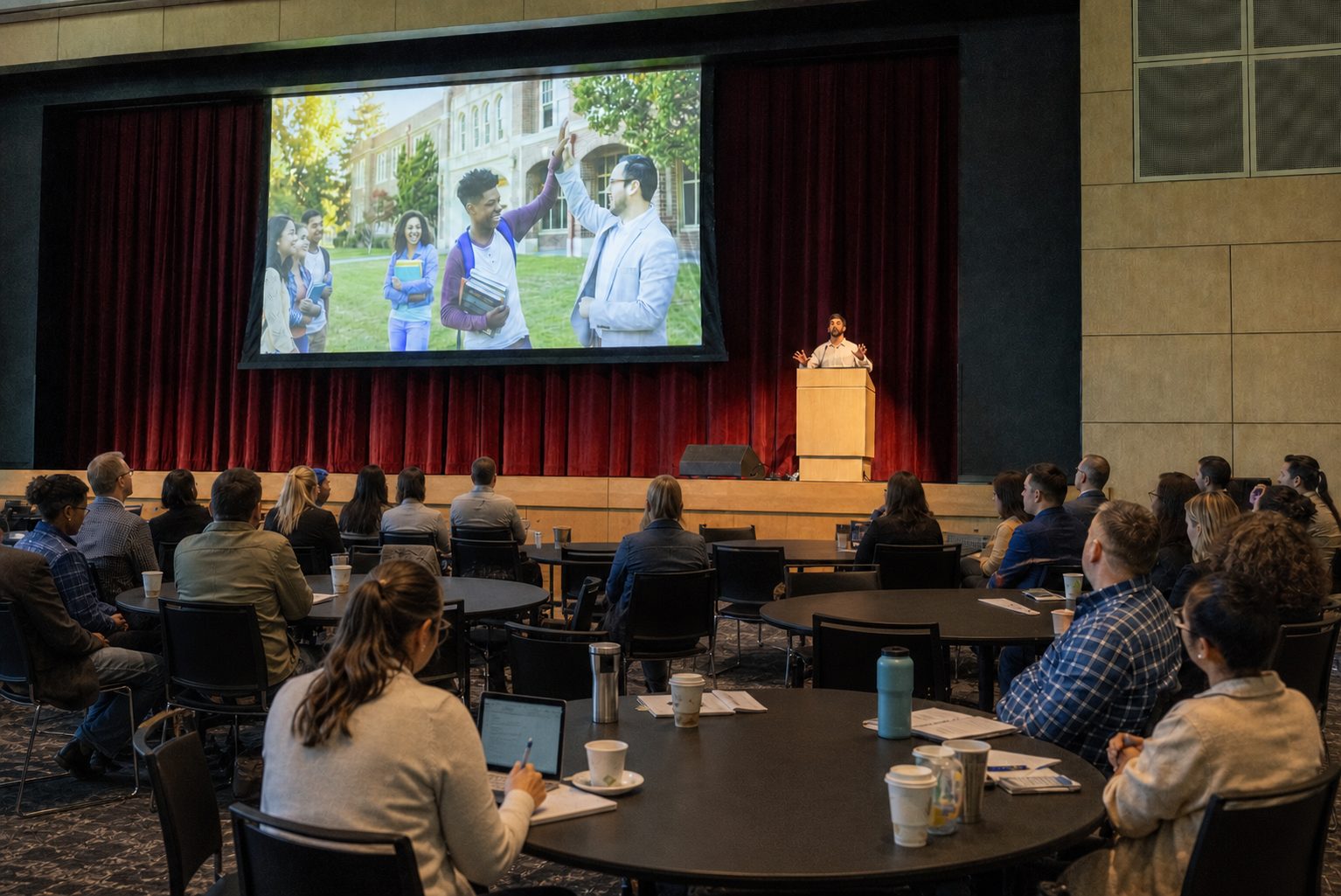
A student assembly, a parent and guardian evening, and a faculty in-service are three different sessions, and a speaker who delivers substantially the same content to all three is not tailoring the work. Start by identifying which of these you are actually running, because it determines everything else.
One more thing separates a session people talk about afterward from one they forget by Friday. Plenty of speakers can explain what is happening. Far fewer send an audience home with something to actually do. Ask what your students, staff, and families will be able to do differently the next morning, and ask it before you sign anything.
| Event Type | Session Format | Primary Audience | What to Ask For |
|---|---|---|---|
| District or state conference on AI and student safety | Keynote, with an optional breakout | Administrators, counselors, technology directors | Data specific to your state or region, and a breakout that goes deeper for the practitioners in the room |
| School-wide parent evening | Talk with live question and answer | Parents and caregivers | A version that assumes no technical background, and something families can take home |
| Faculty in-service or professional development day | Workshop, with time for your own cases | Teachers, counselors, administrators | Classroom activities, policy language review, and coverage of academic integrity |
| Student assembly, middle or high school | Interactive session, separated by grade band | Students | Anonymous live polling, age-appropriate scenarios, and distinct middle and upper school versions |
| Educator leadership summit on digital citizenship and AI literacy | Keynote plus a working session | Instructional leaders, curriculum directors | An AI literacy framework your school can adopt, sequenced by grade band |
| Clinical grand rounds or counselor training | Presentation, with continuing education credit where available | Pediatricians, nurses, therapists, school counselors | Screening language, case examples, and referral pathways |
| Law enforcement or child protection training | Extended training session | School resource officers, investigators, prosecutors | Current case typologies, reporting pathways, and evidence considerations |
Questions Worth Asking Before You Book
Most of these can be answered in a short conversation, and the answers separate speakers more reliably than a website does.
- When was this content last updated, and what changed in it over the past year? AI material goes stale in months, not years
- Does the speaker conduct original research, or synthesize other people’s work? Both can be useful, but only one can tell you what the data says when your audience pushes back
- Does the session end with practical strategies and resources, or with awareness? Ask what an attendee will be able to do differently the next day
- Can you see a recording of a recent session with an audience comparable to yours?
- How does the student version differ from the adult version, specifically? A vague answer here is informative
- Does the speaker use fear appeals? Ask directly, and ask a previous host rather than only the speaker
- Will the session address AI companion apps and emotional reliance, or only academic integrity and deepfakes? These are different bodies of research
- Can one visit cover students, parents, and staff, and will each version be built separately?
- What does the speaker need from you in order to tailor the session to your community?
Common Mistakes Schools Make
These come up often enough to be worth naming.
Treating one assembly as a complete response. A single session raises awareness and does not change a culture. Schools that see durable change pair the assembly with staff training, family communication, and something that recurs.
Giving students and parents the same talk. The concerns are different, the vocabulary is different, and the room reads a recycled session immediately.
Booking on shock value. Sessions built on alarming examples produce a spike of attention and very little behavior change, and they make students less likely to come forward afterward.
Leaving counselors out of the planning. Sessions covering image-based abuse and exploitation reliably produce student disclosures. Counseling staff should know the session is happening and should be available afterward.
Combining grades six through twelve into one assembly. The resulting session is slightly wrong for everyone in the room. Split by grade band where the schedule allows it.
Companies I've Worked With

















































Featured On
























Working With Dr. Hinduja
Dr. Sameer Hinduja is a Professor of Criminology and Criminal Justice at Florida Atlantic University, and Co-Director of the Cyberbullying Research Center. His research on youth and technology has been cited approximately 30,000 times, and his current work examines how nationally representative samples of young people use conversational AI and companion apps.
Sessions are tailored to the audience and the concerns of the specific community, and are available in person or online. He presents student assemblies, parent evenings, faculty professional development, AI literacy sessions for school leaders, and conference keynotes on AI risks and harms to youth.
What Hosts Say
“We were fortunate to have Dr. Sameer Hinduja speak to our upper school students on Youth, Generative AI, and Social Chatbots: What We’re Learning, and What Comes Next. Dr. Hinduja connected with our students immediately, using anonymous flash polling to turn a potentially heavy topic into an interactive, engaging experience where students felt safe sharing their own honest experiences with GenAI and chatbots. He skillfully balanced real talk about risks like deepfakes, sextortion, and manipulative content with practical, age-appropriate strategies for media literacy and critical thinking. Our students left not just informed, but genuinely more thoughtful and discerning about how they engage with AI technology in their daily lives. We’re grateful for his expertise and his ability to meet students exactly where they are.”
Matthew Pursel, Upper School Dean, Saint Andrew’s School
“Dr. Hinduja delivered smart, informative, compelling presentations that gave the audiences much to consider. Each was tailored to the particular perspective of the audience. Highly recommended.”
Christopher Keavy, President, St. John Paul II School, Hyannis, MA
“His presentation was informative, engaging, and extremely well-received. Participants praised him as knowledgeable, passionate, genuine, intelligent, and practical.”
Amanda B. Nickerson, Ph.D., Director, Alberti Center for Bullying Abuse Prevention, University at Buffalo
“His keynote on Artificial Intelligence, Online Safety and Children's Rights in the Digital Environment was truly exceptional. He brought a rare combination of global expertise and genuine care for children's rights, helping our audience understand the urgent intersections between AI, online safety, and youth protection in ways that felt both scholarly and deeply human.”
Dr. Bridget Joyce Machaka, Researcher, University of the Free State, South Africa
Common Questions
How do you choose a speaker for a school AI assembly?
Start with who is in the room and how long you have them, then ask whether the speaker conducts original research or summarizes other people's work. The question that separates good sessions from forgettable ones is whether the audience leaves with strategies they can use or only with facts they now know, so ask what an attendee will be able to do differently the next day. Also ask when the content was last updated, how the student version differs from the adult version, whether the session uses fear appeals, and whether one visit can cover students, families, and staff with each version built separately. Ask a previous host, not only the speaker.
What should an AI safety assembly for high school students cover?
It should explain how generative AI and chatbots actually work, how students are really using them, AI companion apps and emotional reliance, deepfakes and AI-generated images of classmates, AI-driven catfishing and sextortion, and the judgment that helps students use these tools well. A good session separates genuine risk from moral panic. Most importantly, it should close on practical strategies students can actually apply, because an assembly that only conveys information changes what students know and not what they do.
How long should a parent night on AI run?
About an hour with time for questions works well for most school communities. The question portion is often the part families value most, so it should not be squeezed. Anonymous audience polling can be included so parents see how their own community answers questions they assume they are alone in asking.
What is the difference between an AI literacy session and an AI safety session?
An AI safety session addresses what can go wrong, including companion app reliance, deepfake abuse, harassment, and exploitation, and is usually delivered to a whole community. An AI literacy session addresses what students should be able to do with these systems and is usually delivered to the people who decide what gets taught. Most schools eventually need both.
Can one speaker cover students, parents, and staff in the same visit?
Yes, and many schools do this deliberately so the whole community works from the same information rather than three disconnected messages. What matters is that each version is built separately for its audience. Ask the speaker directly how the versions differ.
Should a school book an AI speaker or an AI software vendor?
They solve different problems. A software vendor addresses classroom tools, guardrails, and compliance with student data rules. A speaker addresses what students, families, and staff understand and do. Schools often need both, and confusing the two is a common reason a booking disappoints.
Background
per Stanford University and Elsevier
Dr. Hinduja is a Professor in the School of Criminology and Criminal Justice at Florida Atlantic University and a Faculty Associate at the Berkman Klein Center for Internet & Society at Harvard University. He co-founded the Cyberbullying Research Center, has published eight books, and is Co-Founder and Co-Editor-in-Chief of the International Journal of Bullying Prevention. He has testified before the U.S. Attorney General and federal departments and advised the White House across two administrations on youth online safety. You can read his full biography at hinduja.org.
Any questions? Reach out!
Contact Dr. Hinduja