Assemblies, Parent Evenings, and Faculty Training for Independent and Private Schools
Dr. Sameer Hinduja works with independent, private, and faith-based schools on the questions their communities are actually asking about cyberbullying, artificial intelligence, sextortion, social media, and what it takes for students to thrive online and off.
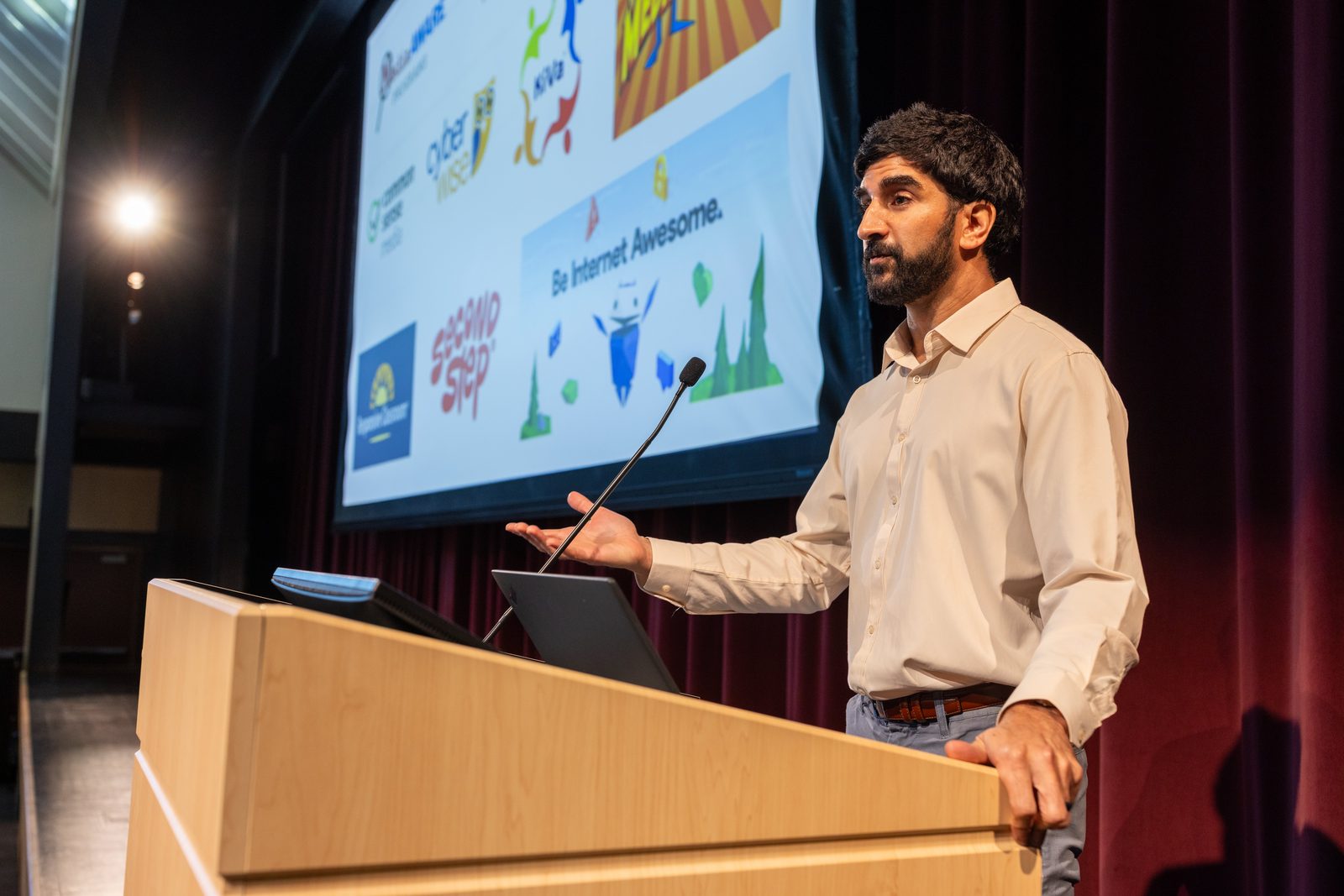
Why Schools Bring Him In
Sameer Hinduja, Ph.D. is a keynote speaker for independent, private, and faith-based schools, a Professor of Criminology and Criminal Justice at Florida Atlantic University, and Co-Director of the Cyberbullying Research Center. He speaks at student assemblies, parent evenings, faculty in-service days, and association conferences on cyberbullying, bullying and school climate, artificial intelligence, sextortion, social media, and digital well-being. His research has been cited approximately 30,000 times.
Independent, private, and faith-based schools sit closer to their families than almost any other institution. When something reaches students first, whether that is a new app, a deepfake incident, or a sextortion attempt, parents expect the school to have a clear answer. Most schools are working without a clear picture of what is actually happening on their own campuses.
Dr. Hinduja gives students, parents, and faculty that clear answer, drawn from his own research rather than from headlines. He has studied youth and technology for over two decades, and he speaks about it without fear tactics, without moralizing, and without talking down to the students in the room.
He has presented at the national conferences of the National Association of Independent Schools (NAIS) and The Association of Boarding Schools (TABS), and for regional associations including the Association of Independent Schools in New England (AISNE) and the Association of Independent Maryland and DC Schools (AIMS). He has also spoken at individual independent, Catholic, Christian, and Jewish day schools across the United States, tailoring each visit to the age group and to the character of the community.
Topics
Every topic below comes from his own research program, and each can be adapted for students, for parents, or for faculty.
Artificial intelligence, chatbots, and deepfakes
How generative AI works, how students are actually using it, and where the real risks sit. Covers AI companion apps and adolescent attachment, deepfake and image-based abuse among classmates, AI-facilitated harassment, and the media literacy that helps students navigate these tools rather than fear them.
More on AI for schools →Cyberbullying
Dr. Hinduja helped define this field and has collected data on it since the early 2000s. The session covers what cyberbullying looks like on campus now, what schools can and cannot do about off-campus speech, how to respond in a way students trust, and how to build the reporting culture that prevention depends on.
More on cyberbullying →Bullying and school climate
Bullying prevention that starts with climate rather than consequences. The session addresses belonging, empathy, resilience, and the conditions under which students look out for one another, along with the practical steps a school can take this year.
More on bullying prevention →Sextortion and image-based abuse
Financial and sexual extortion of minors has become one of the most urgent threats schools face, and adolescent boys are frequent targets. The session covers how these schemes work, why victims stay silent, what a school should do in the first hour, and how to talk with students about it without shame.
More on sextortion →Social media and youth
What the research actually shows about adolescents and social media, separated from the moral panic on one side and the dismissiveness on the other. Practical guidance for families who are trying to decide what to allow, and for schools deciding what to teach.
More on social media →Digital well-being and screen time
Attention, sleep, comparison, loneliness, and the habits that support a student's mental health in a connected life. The session gives parents and faculty something more useful than a screen time limit, and gives students a reason to care.
More on digital well-being →Companies I've Worked With























































Featured On

























Formats for Your School
A campus visit can bring together several audiences in a single day, or focus on one. Each session is tailored to the division and to the concerns of your community, and all are available in person or online.
How the Sessions Work
Students are the toughest audience in any school, so the student sessions are built around them rather than at them. Through anonymous flash polling, students answer questions from their own phones and then see, in real time, the attitudes and behaviors of their own peers rather than a national statistic. That is usually the moment a room goes quiet and starts paying attention.
Parent evenings are built for families who feel behind, and faculty sessions are built for educators who need something they can use on Monday. Every session closes on the protective strengths that schools already care about, including media literacy, critical thinking, resilience, empathy, and sound judgment, and every session sends people away with resources they can keep using after the visit ends.
Trusted by Independent and Faith-Based Schools
"Dr. Sameer Hinduja educated Williston students, and a gathering of parents the evening before, about the clear and present dangers of teenage social media use. An expert in his field, and a professor who connects quickly with middle and upper school students."
Robert W. Hill, Head of Schools, Williston Northampton School, Easthampton, MA
"What I love most about Dr. Hinduja's presentations is how he speaks with the students. Like a master teacher, he makes it clear that the space is safe for all types of comments and questions. Our students walked out feeling that they had been part of a discussion, and for the faculty and families, his current research astounds us."
Sarah Kemeness, Head of Upper School, Palm Beach Day Academy, Palm Beach, FL
"Sameer not only speaks with authority about the ins and outs of technology and social media use, but also emphasizes the interplay between kids' on and offline lives. The feedback from our parent community was incredible, and our students loved him too. He is a brilliant presenter and a compassionate and knowledgeable educator."
Phyllis L. Fagell, LCPC, School Counselor, Sheridan School, Washington DC
"Dr. Hinduja delivered smart, informative, compelling presentations that gave the audiences much to consider. Each presentation was tailored to middle school students, high school students, and parents, and hit the mark. As a faith-based school, I appreciated the spiritual grounding Sameer was able to share with students. Highly recommended."
Christopher Keavy, President, St. John Paul II School, Hyannis, MA
"It is an honor and privilege to recommend Dr. Hinduja as a guest speaker for your school assembly on digital safety and cyberbullying. He wowed all of our audiences, parent, elementary, middle and upper school, with his knowledge, professionalism, and ability to captivate. If you are looking for someone to speak about digital safety and cyberbullying, you need not look any further."
Susie London, Psy.D., Middle and High School Psychologist, RASG Hebrew Academy, Miami Beach, FL
"He has a way of capturing his audience from the start. He also addressed our parents during an evening event, and offered faith-based advice on how to parent in this digital generation. His focus on building our children's resilience, empathy, and discernment was invaluable. I highly suggest having him speak at your school."
Brian Urichko, Assistant Principal, Upper School, The Master's Academy
"A reflective and kind person. A genuine expert in his field. A sincere yet entertaining speaker who truly knows his audience and how to engage with it. Sameer was such a pleasure to have speak to our students and parents, and he made the planning and delivery of his visit truly enjoyable and easy. I whole-heartedly recommend inviting Sameer to speak with your school community."
Kris Marchant, Health and Wellness Coordinator, The Steward School, Richmond, VA
"It was an absolute privilege to have Dr. Sameer Hinduja come speak with our students and caregivers. He had a speaking style that immediately engaged and connected with our high school students, and his use of anonymous polling was incredibly effective. As his main contact, I found him responsive, professional, and enjoyable to work with."
Abby Rotwein, Director of Equity and Inclusion, Riverdale School District, Portland, OR
Common Questions
Who is a good speaker for an independent or private school?
Independent and private schools tend to want one visit that serves students, parents, and faculty, and they tend to want the content adjusted to their own community. Sameer Hinduja works with independent, private, and faith-based schools on cyberbullying, artificial intelligence, sextortion, social media, and digital well-being, and a single visit can include a student assembly, a parent evening, and faculty training.
What topics can Dr. Hinduja cover at our school?
Cyberbullying, bullying and school climate, artificial intelligence and chatbots and deepfakes, sextortion and image-based abuse, social media and adolescent mental health, and digital well-being and screen time. Each topic is drawn from his own research and adapted to the age of the audience and the character of the school.
Can a single visit cover more than one topic?
Yes, and most school visits do. A common structure is a student assembly by division, a parent and caregiver evening, and a faculty in-service, each addressing the topics most relevant to that audience. A half-day or full-day program can move across several topics, or go deep on one.
What formats can a school visit take?
Student assemblies by division, lower and middle and upper school sessions, parent and caregiver evenings, faculty and staff in-service, professional development days, board and leadership briefings, counselor and wellness team training, and association or conference keynotes. All are available in person or online.
Can a faith-based school request content that reflects its values?
Yes. Dr. Hinduja has spoken at Catholic, Christian, and Jewish schools, and hosts have welcomed his emphasis on character, resilience, empathy, and discernment, and his willingness to reflect the spiritual grounding of the school community.
Are the sessions appropriate for parents and faculty who are not technical?
Yes. Every session is written for a general audience and explains how the technology works in plain language, without assuming any technical background, and without relying on fear or scare tactics.
Background
per Stanford University and Elsevier
Dr. Hinduja is a Professor in the School of Criminology and Criminal Justice at Florida Atlantic University and a Faculty Associate at the Berkman Klein Center for Internet & Society at Harvard University. He co-founded the Cyberbullying Research Center, has published nine books, and is Co-Founder and Co-Editor-in-Chief of the International Journal of Bullying Prevention. He has testified before the U.S. Attorney General and federal departments and advised the White House across two administrations on youth online safety. You can read his full biography at hinduja.org.
Any questions? Reach out!
Contact Dr. Hinduja